
Most companies know how significant SEO can be for their operations; however, not all of them realize the specifics of SEO processes. Some think that SEO is simply about keyword integration on web pages, and others believe that some backlinks will increase the rankings of a website. However, a successful SEO strategy consists of a number of steps that form a process and improve website visibility in search engines.
Search engines take into account hundreds of aspects while indexing sites in their databases. Consequently, SEO cannot be described by a single step but is a comprehensive strategy including among other things research, technical, on-page, user experience optimization and tracking.
Such a tactic enables a firm to target the right audience instead of focusing on traffic generation.
Every step of an SEO process plays its role in achieving organic growth. Missing one step usually results in decreased efficiency of the whole SEO strategy.
You will get to know all about the SEO Process Step by Step in this guide and will be able to find out why each step is important and how businesses make their search presence sustainable in 2026.
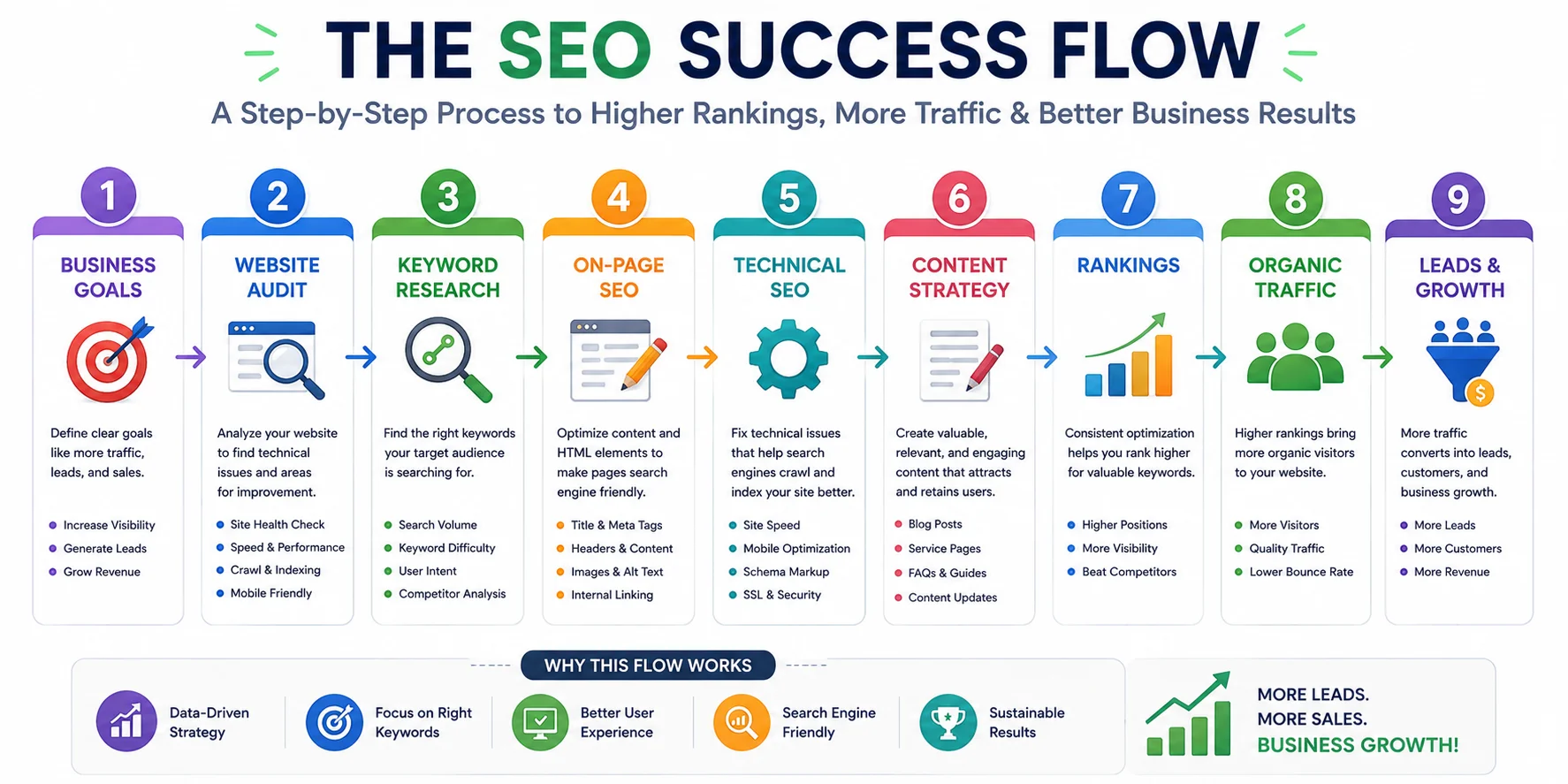
The Significance of Utilizing a Well-defined SEO Methodology
SEO is often misperceived, given that most individuals tend to focus on their end results of ranking instead of the techniques used to attain them. It is vital to have an organized methodology; otherwise, companies may be publishing random content, selecting irrelevant keywords, or skipping technical areas that could hinder search engines from understanding their website accordingly.
Implementing a structured approach means that every optimization project will have a higher goal beyond just performance improvement – it will draw from prior steps instead of coming up with separate improvements. For instance, keywords will be used to create necessary content, technical SEO will improve crawling efficiency, and internal linking will improve topic authority with continuous monitoring letting companies know how to improve their performance further.
Thanks to proper methodology, companies do not waste time on the obsolete methods and techniques that do not bring results.
Step 1: Understanding Business Goals Before SEO Optimization
Each SEO campaign starts with knowing the client’s business well. This means learning the goals of the business before keyword research or any other optimization can take place.
There are businesses whose goals are to increase the number of leads they get, while others wish to increase their online sales, or attract local clients or even create more brand awareness. All these factors play a role at each step of the SEO process.
The next thing to learn about is the target customer. There are various customers who speak different languages, have different problems, and require different types of content on their pages. Failure to understand the intention of users usually ends up in getting traffic which does not convert.
This is also the time when a business evaluates its competition and how its present online.
Step 2: Website Audit
There will be no improvement without knowing the current situation. Auditing is an approach that helps to determine technical issues, content quality, user experience, and SEO-readiness of the website.
During the audit, specialists estimate how likely it is for search engines to discover, crawl, and index the important webpages. Also, website speed, mobile responsiveness, broken links, duplicate content, URLs, metadata, internal linking, and website architecture will be tested during the audit.
The next thing during the audit process is the analysis of the content quality. Currently existing pages will be estimated for their capability to satisfy the user’s needs, use proper keywords, and have enough content to overcome competing websites.
Website audit does not only detect problems but can become a guide for the future SEO optimization. Solving technical problems and preparing website for the new content will improve future SEO efforts.

Step 3: Conducting Keyword Research
A company needs to research the keywords in great depth prior to formulating an SEO strategy. This eliminates the need for the business to guess what keywords its target customers are using to search for information about its products and services. Through the process of keyword research, the business will be able to find out the keywords used by its customers to search for information.
In the modern keyword research process, search volume is just one of the many factors. During the process, researchers consider such aspects as search intent, competition, relevancy, and commercial value of certain keywords. For example, a term with a low search volume but high commercial intent is more valuable than a popular keyword.
During the process of keyword research, researchers not only find related keywords but also other terms, questions, and semantic keywords, thus creating the possibility to develop content around a certain topic.

Step 4: Competitor Analysis
Competitor analysis is a crucial aspect of the business which allows the entrepreneurial organizations to find out the reasons for success of other websites in the search results. What is important is that copy does not make sense; rather it gives the companies the chance to find out the opportunities to create something better.
At this stage, the companies look at their competitors’ websites, their content, keywords, backlinks, page arrangement, and internal linking. The more the companies know about their rivals, the greater the chances of finding gaps for their website.
Another important thing that needs to be done is identifying the type of content that is doing well for the keywords. The companies have to understand that in some cases they need to create detailed guides, while in other cases they need to create comparison and service pages, as well as FAQ pages.
Step 5: Development of an SEO Strategy
Following the research phase comes the step of developing a good SEO strategy. During this phase, links are made between company goals and actual SEO actions.
This strategy determines the choice of keywords, pages that need optimization, creation of new content, as well as technical optimizations. It also sets the schedule of posting articles, linking and measuring performance.
A good strategy will make a combination of quick wins and future development. Less competitive areas will bring quick wins, while broad areas will build up the authority.
As opposed to businesses that respond to changes in algorithms, companies working according to a strategy stay focused on bringing value to the user.
SEO Services in Mohali
Are you interested in improving your website by implementing a well-planned and structured SEO strategy? We provide you with SEO Services in Mohali that offer you coverage from start to finish of the entire SEO process – from technical SEO to keyword research, content creation and more.
Keyword Research Guide
Keyword selection is one of the critical components of SEO. The Keyword Research Guide highlights all the aspects involved in identifying the keywords that will bring your target audience rather than boosting your website traffic.
Step 6: On-Page SEO Optimization of Important Pages
Following an SEO plan creation and conducting of keyword research, comes page optimization to make sure that both visitors and the search engines know what the pages are all about. This stage is known as On-Page SEO, which refers to the optimization of all possible elements on the website.
Each page needs to have a single theme, a good title tag, a good meta description, correct headings, proper image alt tags, and the placement of keywords. However, modern On-Page SEO techniques do not involve stuffing keywords. The idea behind on-page SEO is doing a better job of answering users’ queries than any other page does.
The content needs to be clear, well-written, and useful. Sites which are able to meet user intent get higher ranking positions from the search engines in comparison with sites that only incorporate the selected keyword.
Internal links become crucial at this stage since they help the visitor find the right pages and allow the search engine understand how the pages are interconnected.

Step 7: Enhancement of Your Website with Technical SEO
Having technical troubles ensures that the best content won’t rank well. There’s a need for conducting a technical SEO audit for sites to ensure the site is secure, fast, crawled and indexed by search engines.
Doing so helps with speed optimization; finding broken links; improving core web vitals; organizing structured data; creating an XML sitemap; keeping robots.txt files up to date and mobile optimization in mind. There shouldn’t be any duplicates or redirects on your site pages.
Technical SEO is performed out of public view meaning that certain improvements cannot be seen by the users. Nevertheless, these criteria are taken into consideration when search engines evaluate the website quality. When the website is technically healthy, it will be crawled effectively by search engines.
When businesses pay attention to their technical aspects, they ensure that they will not face indexing problems in the future.

Step 8: Creation of High-Quality Articles for Building of Topic Authority
Having done with the technical part, the last remaining and most crucial step to accomplish is creation of high-quality articles. It is now impossible to become successful in SEO by creating a huge amount of content; it is necessary to create such a piece of content which would answer users’ queries better than the competitors’ content.
For creation of quality content, it is necessary to know customers’ intention. It is not sufficient to write just blog articles; it is also necessary to create content which would help sell the products/services of the company and answer all customers’ questions.
A web page acquires the status of one of the authoritative sites in the field when it receives this designation from the search engines. The information presented on that web page must be original, relevant, up-to-date, and expressed in an intelligible way. The web page may contain illustrations to show its points.
The more content on the company’s website there will be, the more topic authority will be achieved among the articles by means of internal linking.

Phase 9: Create an Efficient Internal Linking System
Internal linking is an area of SEO that is generally given little attention, however it is very important to both users and search engines as it helps them navigate the website.
When users get to know of related pages without searching again, their experience becomes enriched and they are able to locate other useful information.
From a search engine perspective, internal links distribute the authority among various pages as well as demonstrate how the pages are related to each other. For example, a blog post related to SEO can have links to the articles related to keyword research, technical SEO, and content optimization.
The most effective internal linking approach is purely based on relevance. The links should be aimed at improving the experience of the reader and providing him or her more information.
Step 10: Monitoring Performance and Constant Improvement
SEO is never done once and for all. The search engine algorithms are constantly updated, new articles appear on competitors’ websites, and the searches of customers evolve constantly. As such, continuous improvement and performance monitoring is required in order to successfully carry out an SEO strategy.
One should monitor the rankings of keywords used, the amount of organic traffic, click-through rates, user engagement, and conversions of different pages to know what pages perform good and where improvement is needed.
Moreover, old articles should be refreshed by adding new facts, examples, and other sections. Updating of content often yields better results than creation of new pages.
Typical SEO Process Flaws Companies Should Avoid
Often, the reason behind the failure of the majority of SEO campaigns is not an ineffective strategy, but rather skipping some crucial steps, as well as inconsistent implementation of certain elements. Many companies start writing content before conducting keyword research, which makes it impossible to attract the right audience. Others neglect technical SEO issues, being convinced that content alone can improve ranking.
Waiting for quick results is yet another typical flaw, as SEO takes time and requires persistent efforts. Some companies concentrate only on driving more traffic while completely forgetting about conversion optimization and thus driving many visitors without turning any of them into clients.
Writing low-quality articles just in order to generate more pages is yet another problem, as search engines prefer websites that value depth and uniqueness of their content over its quantity.
On-Page SEO Manual
If you want to find out how to optimize each page for search engines and users alike, our On-Page SEO Manual explains title tag, headings, optimization of text and images, internal linking and various other important on-page factors.
Technical SEO Manual
Technical optimization is very important for successful long-term SEO. Our Technical SEO Manual includes site speed, crawlability, indexability, structured data, Core Web Vitals and other technical aspects of SEO.
Conclusion
SEO Process Step by Step is not merely a series of separate activities but a system that is aimed at increasing the effectiveness of a web site, its visibility, and authority in search engines. Whether it is about studying the goals of the company, choosing keywords, making necessary changes in technical part, creating quality content, and analyzing the performance of the website, every step is needed to ensure sustainable organic development.
Following a proper SEO process helps companies attract qualified visitors, enhance user experience, and be competitive enough in search results. Instead of seeking easy ways to rank up in Google and other search engines, one should consider working on the development of a more effective SEO strategy in the long term.
Alsi read other article: https://raviseo.com/why-local-businesses-need-seo-services-in-2026/
Follow Our Page
Learning More Through Social Bookmarking Websites
In order to see how social bookmarking works in practice and how it can help with finding useful information, increase visibility of websites, and improve SEO, you need to see the following sites that provide relevant information on social bookmarking.