
Each and every time you go to Google to seek for information, there are many websites trying to get their site listed in the first page. However, Google is able to figure out what the best sites are and present them to you based on their usefulness within a couple of minutes. But have you ever wondered how Search Engines Work?
If you somehow deal with SEO, digital marketing or have a website, it is crucial to know the way search engines operate. No matter if you have a local business site, an online store or blog, understanding the way search engines work will give you an idea of what content should be created.
The thing is, search engines do not choose one site among others; they use a certain algorithm which consists of searching for webpages, saving them into a huge database and analyzing a bunch of ranking factors.
In this article, you will find out how search engines work, what does crawling, indexing and ranking mean and how you can adapt your website to the process.
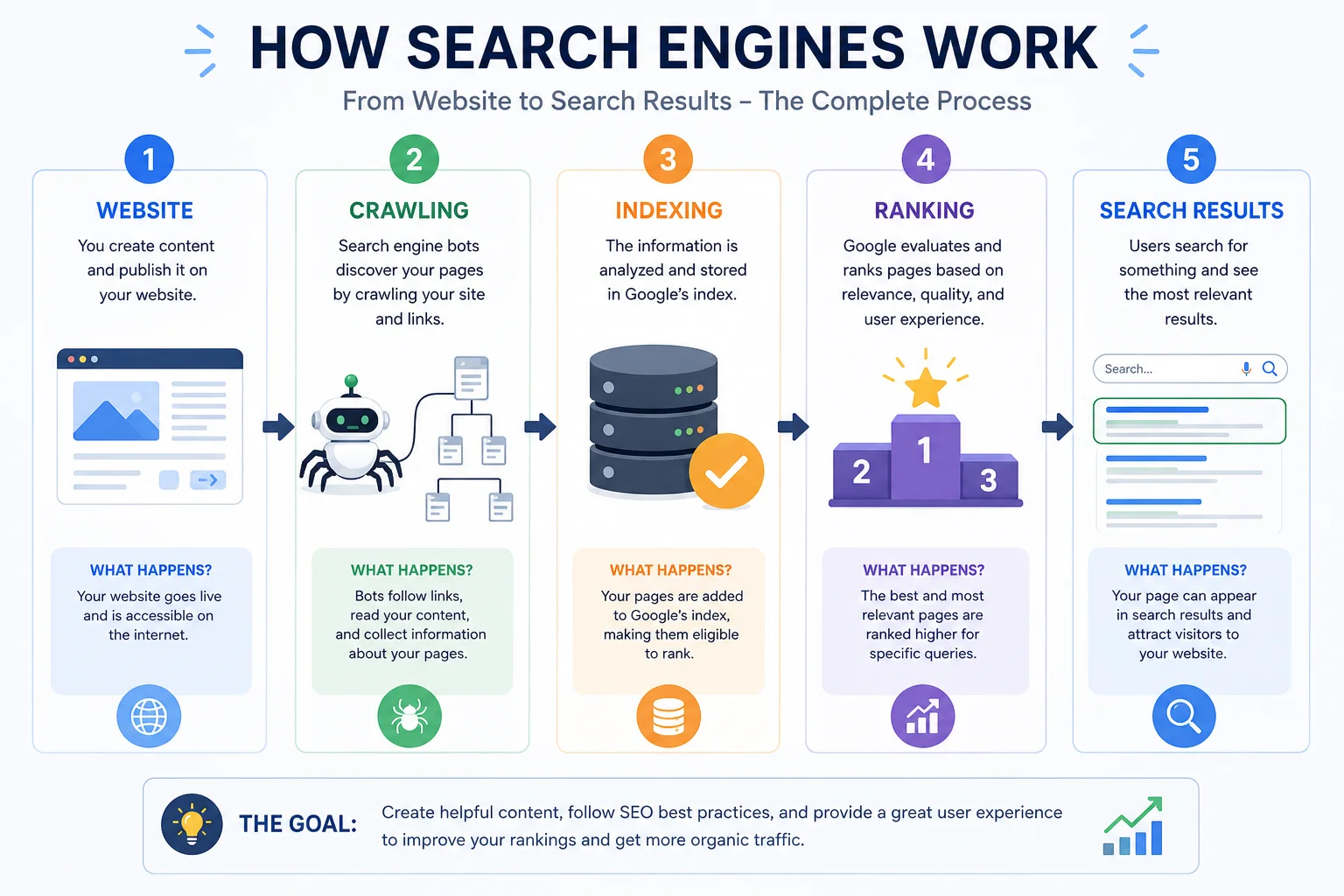
What Is a Search Engine?
It is a computerized system used to find information available on the internet. Search engines scan billions of websites and provide users with the best results through storing relevant data based on the queries entered by the user.
The popular search engines are as follows:
- Bing
- Yahoo
- DuckDuckGo
- Baidu
- Yandex
Of all these, Google leads the world search engine market and therefore becomes the main SEO target.
The significance of understanding search engines
Without the proper comprehension of how search engines trace and examine websites, it is difficult to work on raising the ranking of those sites.
Being aware of how search engines function, you will be able to:
- Create SEO friendly content
- Advance website design
- Fix problems with indexing
- Enhance website performance
- Raise the volume of organic traffic
- Be a good authority on the subject matter
The knowledge of how search engines operate will make it easier for the companies to make decisions in a field of search engine optimization.
The Three Main Stages of How Search Engines Work
Every search engine follows three major steps before displaying search results.
- Crawling
- Indexing
- Ranking

Stage 1: Crawling
Crawling refers to finding pages on the Internet.
Search engines have automated programs called crawlers, spiders or robots that go on to search engines regularly. The title of Google’s crawling software is Googlebot.
First of all, this software locates existing websites and thereafter finds new web pages through their links.
It looks for:
- New pages
- Updated pages
- Images
- Videos
- PDF files
- Internal links
- External links
Good structuring of the website makes crawling easy for search engines.
Factors That Make Crawling Easier
These include the following:
- XML sitemap
- Internal links
- Navigation bars
- Fresh content
- Quality backlinks
In case key pages lack internal links, crawlers will never get to those pages.

Stage 2: Indexing
After discovering a webpage, the search engine examines the contents of that webpage.
In case the webpage qualifies, it is added to the search engine’s index.
The index can be considered a virtual library consisting of billions of websites.
While indexing, Google gets to know about:
- Page title
- Headings
- Contents
- Images
- Keywords
- Structured Data
- Internal links
- Mobile usability
Indexing is crucial for being found on search engines.
The reason why some websites do not get indexed.
The usual culprits are:
Noindex directive
Duplicate content
Low quality content
Faulty webpage
Crawl error
Disallowed via robots.txt
Keeping track of indexing issues through Google Search Console is helpful.

Stage 3: Ranking
After a web page has been indexed by Google, it will assess its ranking based on certain criteria.
Ranking involves hundreds of ranking signals rather than just one.
Among the most influential ranking signals are:
- Search intent
- Content quality
- Relevance
- Page speed
- Mobile-friendly
- Backlinks
- Internal links
- User experience
- Website authority
- Freshness of the content
All actions mentioned are meant to provide the most adequate answer to the user.
What Happens When Someone Searches on Google?
Consider someone who searches for:
“Best SEO Agency near me”
What Google will do is:
- Interpret the search intent.
- Search its index.
- Compare the related pages.
- Evaluate the ranking factors.
- Present the best results.
All mentioned actions take place within a second.

Factors That Influence Website Ranking
To know how search engines operate also entails knowing what affects ranking positions.
- Quality of Content
Beneficial, unique, and useful content ranks higher than irrelevant or duplicated information.
Content must address the users’ needs completely instead of keyword repetition.
- Search Intent
Google is trying to find out what the users really need.
Examples:
Informational searches
Commercial searches
Transactional searches
Navigational searches
It is very important to match the search intent as this will help you rank.
- Website Speed
Slow websites do not provide good user experience.
High-speed loading websites tend to have lower bounce rates and are more satisfied by the visitors; hence they rank higher.
- Mobile-Friendliness
Currently, most searches are done from mobile phones.
Responsive websites which operate without any glitches on all screen sizes are ranked better.
- Backlinks
When reputable websites link back to your website, then search engines treat them as credibility signals.
Quantity never beats quality here.
- Internal Links
Internal links helps in bringing discoverability of your content to the crawlers of search engines as well as authority in the process.
When your page have more links it makes easier for the crawlers to crawl and index..

When do search engine crawl my site?
There is no schedule
Highly popular sites that update regularly get more frequent crawls.
Some of the reasons why websites attract regular crawls include:
- Updating new content on your website
- Strong internal linking
- XML sitemaps
- Good backlinks
- Website speed
Crawling helps show that your website is alive.
Common SEO Mistakes Impacting Crawling and Indexing
There are various websites which have problems ranking due to inability of search engines to crawl them properly.
Avoid making these mistakes:
- Faulty internal links
- Absence of XML sitemap
- Duplicate content
- Low website speed
- Content thinning
- Robots.txt issues
- Redirect loops
- Weak website navigation
Solving these problems will make the process easier.

Best Practices for Better Search Engine Visibility
For better rankings, you should:
- Produce quality and useful content.
- Structure your site.
- Establish good internal links.
- Increase your page speed.
- Update your XML sitemap.
- Ensure mobile-friendliness.
- Have descriptive title and header tags.
- Update your old content regularly.
- Check Google Search Console for any crawl errors.
All these efforts help search engines crawl and rank your site.
SEO Services in Mohali
To have your site crawled, indexed and ranked correctly, our SEO services in Mohali concentrate on technical SEO, content marketing, internal linking and long-term organic growth based on your business objectives.
Keyword Research Guide
In order to understand how search engines work, one needs to understand what people search for. To do that, read our Keyword Research Guide and find out how to uncover keywords relevant for your content strategy.
Technical SEO Guide
Technical SEO is crucial for crawling and indexing processes and overall performance of your site. Find out how it works from our Technical SEO Guide where we talk about XML sitemaps, robots.txt, Core Web Vitals, structured data and other technical aspects of SEO.
What is SEO?
For beginners in optimization, we recommend reading our article What is SEO? to get a general understanding of search engine optimization and its importance for business.
Conclusion
Understanding the mechanisms of search engines is the first step in implementing any good SEO strategy. Each of the stages – from crawling to ranking – determines whether the content can be found and presented to the audience.The quality content creation, the website’s optimization, and the right internal links will ensure that the search engines get a better understanding of your site and boost its visibility. The optimization process will provide you with higher rankings, more organic traffic, and topica authority.