
Are you aware that you have encountered a specific question over the internet through an online search engine such as Google? Afterward, were you interested in clicking on any of the top-ranking results from the search engine? This is what is referred to as the use of SEO.
SEO, which stands for Search Engine Optimization, is a practice of optimizing a website to appear on search engines as high as possible while people search for related content. If your pages rank higher on Google search, you get a bigger chance for your website to be found by your potential customers.
Be it your local small business, online store, blog or company website, SEO will help you connect with people who are already interested in what you have to offer.
As opposed to paying for marketing, when it comes to SEO, there is a need for you to earn traffic through natural search engine results. Even though it takes much time and effort to apply SEO, it is worth it owing to the advantages associated with it.
Why Is SEO Important?
Many people use Google everyday in their attempts to solve a problem, compare things, find local businesses or get some information.
What if you have a bakery? Let’s say a client is searching for the best bakery around him/her.
In case your website is on the first page, the probability that he/she will either come to your store or contact you is very high. If your website appears on the fifth page, nobody will even bother to open your webpage.
This is what SEO accomplishes.
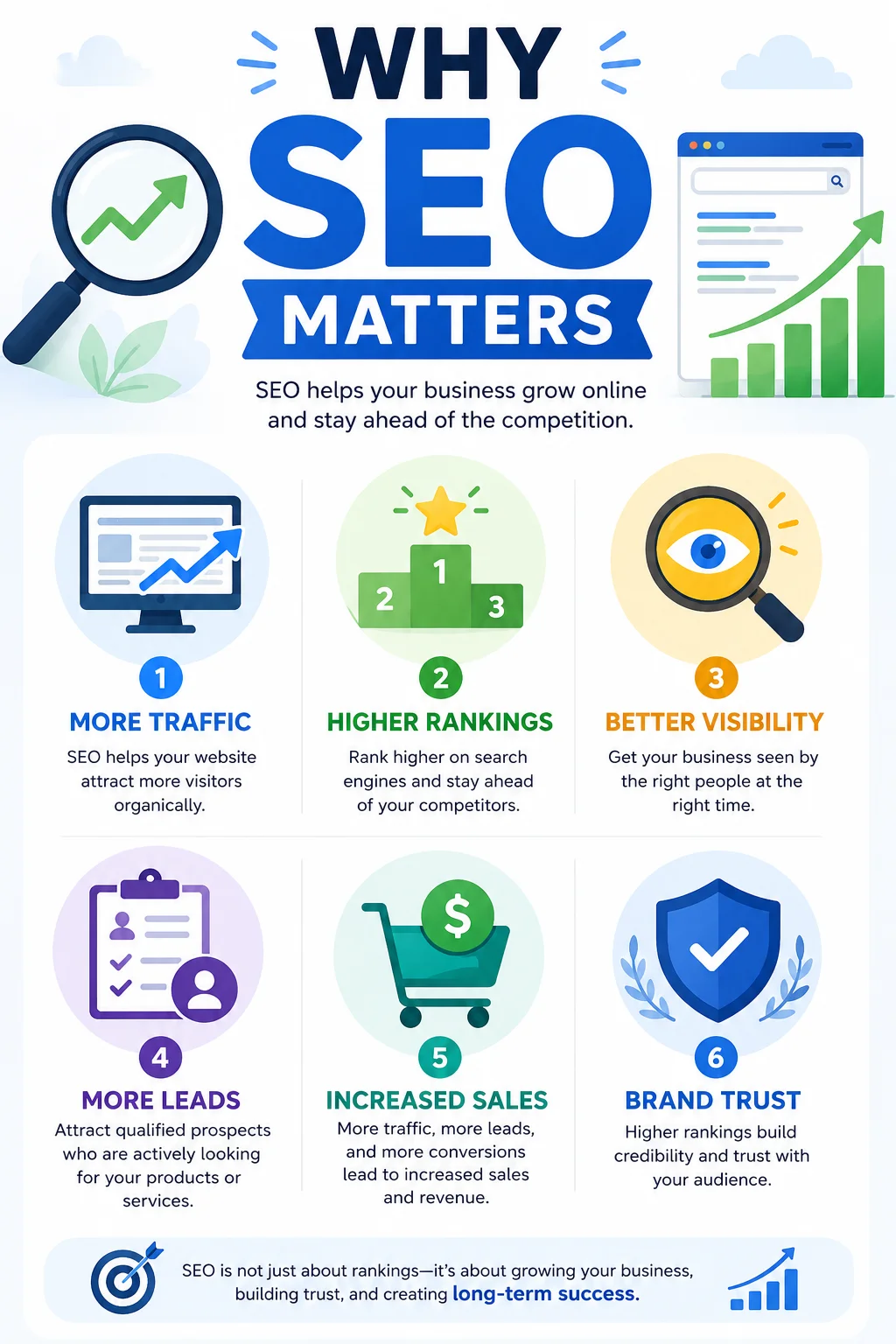
SEO helps to ensure that your website:
- Connects with your target audience
- Grows organic website traffic
- Acquires more credibility and trust
- Provides leads
- Becomes more visible online
- Helps your business grow
While disturbing customers with intrusive advertising, SEO helps your business to appear while the customers are actively looking for something you offer.
What Does SEO Stand For?
SEO is stands for Search Engine Optimization.
Now let us analyze each word.
Search Engine
A search engine is an interface through which people can search for information on the internet.
Some common search engines are:
- Bing
- Yahoo
- DuckDuckGo
Of all the above mentioned, Google processes the largest number of search queries from around the world, making it the central point of focus of any SEO effort.
Optimization
Optimization refers to the process of improving something in order to get desired results.
When it comes to SEO, optimization refers to making your website more accessible to the search engines as well as to the visitors.
This process involves the improvement of:
- Website content
- Website speed
- Website mobility
- Link building on website
- Website architecture
- User experience
In this way, the engines will understand your website better and possibly give your website a better rank on relevant searches.
How Does SEO Work?
Beginners believe that all SEO does is to add keywords to a page. That is far from the truth.
There are hundreds of factors that a search engine considers before ranking your page.
Usually, the SEO process is as follows:
Step 1: Search Engine Discovers Your Website
The search engines utilize automated bots to crawl through millions of websites online.
The bots crawl through websites following links and identifying content.
Step 2: Your Content Gets Indexed
The process of indexing occurs after the search engine has found your website. In this stage, the search engine reviews your website content and indexes it into its database.
If your page has not been indexed, then it will never be ranked.
Step 3: Google Understands Your Content
The search engine takes into consideration factors like:
- Topic of the page
- Quality of the content
- Headings
- Images
- Keywords
- Links between pages
- Experience of the use
What it tries to find out is what information your page offers and whether there is any benefit for searchers.
Step 4: Pages Are Ranked
As soon as a searcher types in his/her keyword into the search engine, the engine starts comparing relevant pages according to their usefulness, relevancy, authoritativeness, and general quality.
Those pages which best suit the query of the user will most probably be ranked high.

What Is Organic Traffic?
Organic traffic is defined as a number of users who get to your site via unpaid search engine results.
For instance, if someone does a search “how to choose running shoes” and lands on your blog from the search results and not because of any advertisement that you paid for, that will be referred to as organic traffic.
The relevance of organic visitors is that they have a need for something and that makes them engage more as opposed to random traffic.
Can SEO Benefit Small Business?
Certainly. SEO is viewed as a tool for the promotion of large companies with significant marketing budgets. Actually, this is one of the best ways for a small business to gain visibility.
For example:
- A local dentist can benefit from location-specific keywords.
- A construction firm can target homeowners in a close area.
- A digital marketing agency can attract companies seeking growth online.
- A local boutique can appeal to customers looking for fashion stores around the area.
Even a new business can achieve success by writing relevant posts, optimizing their site and growing in the online world
What Is the Criteria That Determines the Rank of Websites?
Among the questions asked by newbies, the most relevant one is “Why do certain websites rank at the top of a search engine while others are presented at the end of the pages?”
The solution to this problem is rather simple – search engines try to deliver the most relevant information to their users.
Google will not rank pages just because there is a keyword on them. There are many other factors taken into account.
Below are some of the most significant ranking factors:
1. Content Quality
Quality content is very important for SEO.
It is much easier to get a higher rank on the search engine results page if the site has quality content answering the users’ questions.
Quality content should:
- Answer the visitor’s questions
- Be readable
- Contain real-life examples
- Be kept up-to-date
- Be comprehensive about the subject
Do not write for the search engine robots. When users find your content helpful, search engines will recommend it.
2. Keyword Relevance
The use of keywords helps the search engines understand what your website is all about.
For instance: If your article talks about SEO basics :-
- What is SEO
- Search Engine Optimization
- SEO for beginners
- How does SEO work
helps Google connect your page with relevant searches.
But using too many keywords is not going to have positive results; in fact, it may become dangerous for your optimization.
3. User Experience (UX)
Search engines take notice of the way people use the websites.
A good user experience consists of:
- Fast-loading pages
- Mobile-friendly design
- Clear navigation
- Readable fonts
- Well-organized headings
- Helpful internal links
If users are leaving your site too fast because of bad quality of the site or complicated navigation, search engines will think that the site is not giving users a good experience.

4. Website authority
Search engines take into account whether other reputable websites endorse your content.
If another website links to any of your pages, it’s referred to as a backlink.
Backlinks of high quality function as endorsements. They indicate that your content is worthy of being mentioned by others.
Nevertheless, quality should be valued more highly than sheer numbers. Backlinks from some reputable websites can prove more useful than numerous links of low quality.
5. Technical performance
No matter how great your content is, it will have difficulty ranking if there are technical problems that make it difficult for search engines to access your website.
Technical SEO is concerned with optimizing such aspects as:
- Website loading speed
- HTTPS protocol
- XML sitemap
- Mobility of the website
- Crawling of the website
- Indexing of the website
- Structure of the website
A technically optimized site facilitates efficient crawling and indexing by the search engines.
The process of ranking will become clear to you once you understand how Google finds, crawls, indexes, and ranks web pages. Get detailed information about this through our comprehensive guide on “How Search Engines Work.”
What Are the Main Types of SEO?
SEO is not one thing. There are different types of SEO that work in harmony in order to make a website visible.
1. On-Page SEO
On-Page SEO concentrates on optimizing the content on pages.
It entails:
- Title tags
- Meta description
- Headings
- Content optimization
- Image Alt text
- Linking internally
- Keyword optimization
- URL optimization
This is supposed to guarantee that all the content provided on the pages has value and is meaningful and understandable to both the visitor and the search engine.
2. Off-Page SEO
Off-Page SEO refers to activities done outside your website to build up trust and authority.
Such activities may include:
- Quality backlinks
- Guest blogging
- Branding
- Digital PR
- Social media engagement
- Local Citations
Backlinks usually confer authority or credibility to websites after some time.
3. Technical SEO
Technical SEO guarantees that your website will be easy for the search engines to crawl, understand, and index.
This includes:
- Website speed optimization
- Mobile optimization
- Structured data
- Fixing broken links
- Canonical tags
- Robots.txt
- XML sitemap
- Core Web Vitals optimization
The most well-written content will still require a well-built website to rank well in search engine results.
4. Local SEO
Local SEO helps businesses enhance their rankings in searches conducted in specific places.
Examples include:
- SEO company in Mohali
- Dentist near me
- Restaurant in Chandigarh
- Gym in Delhi
Local SEO concentrates on optimizing business listings on:
- Google Business Profile
- Google Maps
- Local citations
- Reviews
- Location-based content
- NAP optimization (Name, Address, Phone Number)
Local SEO is especially useful if you have clients from a particular state or city.

SEO is not one process. There are many processes involved in it, such as On-page SEO, Off-page SEO, Technical SEO, and Local SEO. Check out how each of them plays an important role in improving your search engine rankings through our comprehensive guide on “Types of SEO.”
Common SEO Myths
There are lots of myths concerning SEO. Here are a few of them.
Myth 1: SEO Delivers Immediate Results
SEO is a process that takes time.
It can take several months to notice the fruits of your labor in a long term optimization program.
Myth 2: More Use of Keywords Means Higher Ranking
Just repeating one keyword does not assure you of good ranking at all.
The current search engines have become smart to interpret meaning of related words; hence relevant information will rank higher than the one containing loads of keywords.
Myth 3: SEO Must Be Done Only Once
You cannot do SEO only once.
Due to frequent changes made by search engines and continuous addition of content done by competitors coupled with user behaviors, it means that SEO must always be repeated.
Myth 4: SEO Is Only For Large Firms
SEO can greatly benefit small firms since it enables them to reach out to their customers with minimal expenditure. Done right, a website can get a top rank regardless of its age.
Advantages of SEO
There is much more to SEO than just getting a good ranking on Google. It requires a careful approach if businesses want to achieve sustained visibility on the Internet, target prospects correctly, and ensure their business growth even without turning to costly advertising.
In what follows there will be the list of all of the important advantages of SEO that must be known.
1. It Guarantees Constant Organic Traffic
One of the key advantages of SEO is its role in bringing customers to your website in a natural way, unlike pay per click, which will stop bringing customers after the end of your budget.
For instance, even if you run an advertisement for a specific amount of time, your educational materials on SEO can be viewed by people on a constant and repeated basis in case they are informative and effective.
2. It Helps Build Trust and Credibility
Whether we want it or not, people tend to trust sites that are displayed on the first pages of search engines, even though a good position does not guarantee quality. It has been proven that users often associate sites occupying leading positions with accurate and trustworthy information.
3. Produces High-Quality Leads
SEO helps to get people who are regularly searching for something.
For instance:
- A person looking up “best running shoes” is probably going to buy soon.
- A person looking up “SEO services in Mohali“ wants to hire an SEO expert.
- A person looking up “how to increase website ranking” is looking for advice.
Since people have specific intentions, SEO produces high-quality leads.
4. Enhances User Experience
Modern SEO emphasizes user experience immensely.
A good SEO optimization ensures:
- Fast-loading pages
- Responsive mobile design
- Simple navigation
- Informative content
- Proper page layout
- Good readability
This way, it serves both the user and the search engine.
5. Has Enduring Value
SEO takes patience but can yield much more enduring results than many other marketing strategies.
The informational blog post created today may continue attracting traffic, backlinks, and leads year after year with regular updates.
This is yet another reason why so many businesses perceive SEO as an investment for the long run.
Apart from ranking, SEO can do much more for you. It will help to attract more traffic, build brand authority, generate quality leads, etc. Read about these advantages and much more in our detailed article, “Benefits of SEO.”

Beginner SEO Checklist
If you are an amateur in the field of SEO, these tips will be helpful.
✔ Know Your Audience
Before you begin creating content, find out what people want to learn.
It is not enough just to write about something – your main goal should be providing answers.
✔ Conduct Keyword Research
Select keywords that fit user intention.
Do not use only competitive keywords; also think about long-tail keywords.
✔ Produce Valuable Content
Each piece of content has to provide the answer to the question raised by the user.
Answer the following questions:
- Does this article solve some problem?
- Is it correct?
- Is it clear?
- Would I recommend this article to somebody else?
The answer is yes – and that’s great!
✔ Organize Content Properly
Use:
- One H1 heading
- Clear H2 sections
- Supporting H3 headings
- Short paragraphs
- Bullet points wherever necessary
Good structure lets users skim through your content with ease and makes it search engine friendly.
✔ Include Internal Links
Internal links help your readers navigate around your site and also help search engines understand the structure of your website.
In the case of this article, the following related pages can be linked to:
- SEO Services in Mohali
- Types of SEO
- Benefits of SEO
- How do Search Engines Function
This will increase the topical authority of your website.
✔ Update Your Content Regularly
SEO is an ongoing process.
Regularly review your key articles to:
- Add new information
- Add better examples
- Fix any outdated information
- Add new screenshots and statistics
By updating one’s content frequently, the high quality of this specific content can be sustained.
Common SEO Mistakes Beginners Should stay Away from
Many websites fail exactly because they make the same mistakes.
Some typical mistakes to avoid include:
- Posting extremely thin content
- Not considering search intent
- Overusing keywords unnaturally
- Creating content for search engines alone
- Failing to remember internal linking
- Having duplicate page titles
- Disregarding mobile optimization
- Neglecting page speed
- Never updating old posts
- Producing content without considering the audience
Being aware of such mistakes early on will help one save much time.

In The End
SEO is not about looking for loopholes or ways of tricking search engines so that your website comes first on the list. SEO is all about publishing quality content that is useful and properly structured so that potential customers can easily find what they want.
As you deliver good information and ensure that your users get an enjoyable experience while visiting your website, the search engines will recognize and regard you as a worthy website. Just bear in mind that SEO is not an instant process, and one cannot simply hope forThird-Party to admit you within a day after employing your service.
Follow This Account
Also read another blog on: https://medium.com/@raviseo7126/why-search-engine-optimization-is-essential-for-businesses-in-2026-b8b36faf4bd7