
The most easily debunked SEO myths are the ones that are largely marketing-oriented. Listings of myths centering around keywords, back links, and other ranking factors are countless. Most of these ranking factors are either old or irrelevant. Understanding the reality of these myths will enable you to look beyond the basics of marketing optimization to serve you better and craft successful SEO strategies.
One of the commonly held beliefs is that using a particular keyword repeatedly, or keyword stuffing, is necessary. Some people still think that buying backlinks will surely help them achieve the first position in the listings, while others are convinced that any search engine optimization campaign is a one-time effort. Nonetheless, none of these myths prove to be true when speaking about the contemporary interpretation of SEO.
Realizing the importance of distinguishing between myths and reality, one has to understand the difference between facts and common misunderstandings about SEO and implement the most effective principles of SEO in practice. Hence, the goal of this article is to debunk several well-spread myths in the field of SEO.
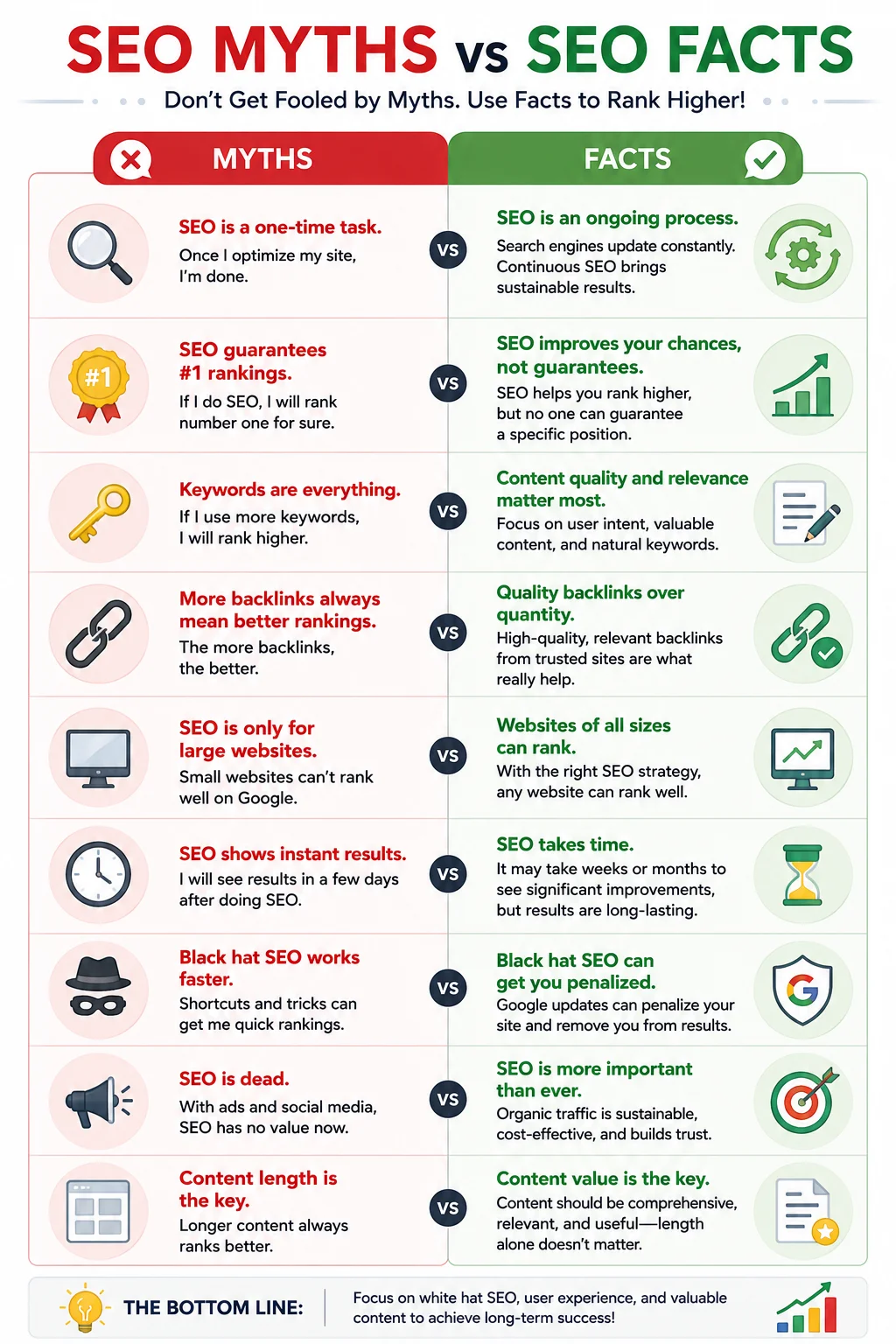
How Did SEO Myths Become Real?
Search engine optimization continues to progress because of the improvements in search engine algorithms. What was relevant information in the past is no longer applicable today but it is still spread on blogs, forums and social media.
Myths in SEO typically come about due to:
- Obsolete techniques of optimization
- False interpretation of Google updates
- Tricks for quick rankings
- Incomplete data
- False marketing claims about fast results
Adhering to such SEO misconceptions will prevent businesspeople from creating a realistic SEO plan.
Myth 1: SEO Provides Quick Results
One of the largest myths is that SEO provides quick rankings.
The Truth
SEO is a long process in which search engines require time to crawl, index, and evaluate your content.
This will depend on many things, such as:
- Competition
- Authority
- Content quality3
- Technical SEO
- Backlinks
- Search intent
Companies that make consistent efforts in SEO tend to have better results than others who only seek quick fixes.

Myth #2: More Keywords Equal Good Ranking
It is thought that repetition of keywords several times will bring better ranking.
Reality
Keyword stuffing doesn’t work anymore and might hurt the clarity of the writing.
In today’s SEO, you need to:
- Use natural language
- Understand user’s intention
- Be relevant on the topic
- Choose semantic keywords
- Provide useful content
Search engines can understand context a lot better nowadays.
Myth #3: SEO is Only About Backlinks
Although backlinks are definitely useful, they are just one of the many elements of SEO.
Reality
Good SEO includes:
- High-quality content
- Technical SEO
- Website speed
- Internal linking
- Mobility
- Good user experience
- Keywords research
This means that you ignore the possibilities your website has to offer.
Myth 4: SEO is done Once for Good
Some companies think that when the website ranks well, then SEO is done.
The Truth
SEO always needs continuous improvement, because:
- Your competitors post new content.
- Searchers’ behavior changes.
- Google modifies its algorithms.
- New keywords appear.
- Your existing content gets outdated.
SEO optimization will help to keep and improve your rankings.
Myth 5: Google Will Automatically Rank Every New Page
If you put out a new page does not mean that it will rank automatically.
The Truth
The page should first be:
- Crawled
- Indexed
- Evaluating
- Compared to other pages
Some technical problems or poor-quality pages do not show up on Google at all.

Myth 6: Meta Keywords Influence Ranking
Years ago websites used meta keywords a lot.
The Truth
Google stopped using meta keywords for ranking years ago.
It is better to focus on:
- Title Tags
- Meta descriptions
- Headings
- Content
- Search Intent
These will have much more effect on SEO than meta keywords.
Myth 7: The More Pages You Have, The Better SEO You Will Get
Owners of websites often make many pages in order to get high ranks using more keywords.
The Reality
What matters is:
- The quality of the pages
- More often than not it is better to have several quality pages than tons of low-quality material.
- Search engines are in search of relevancy and usefulness.
Myth 8: Duplicate Content Means Penalty
This myth is not rare.
The Reality
Typically Google penalizes sites only if they have duplicate content that hurts users. Otherwise it only chooses the version that is most appropriate.
Besides being penalized, sites can face problems caused by duplicate content, such as:
- Misunderstanding of the site by search engines
- Split signals
- Lost visibility
Quality should come first in the end of the day.
Myth 9: Links Bought Will Guarantee Higher Rank
Many companies sell backlinks in order for you to get to the first positions in the search results.
The Reality
Low-quality backlinks can cause you problems.
So it is better to focus on getting backlinks by means of:
- Creating great content
- Being invited to write guest posts
- Partnership
- Digital PR
- Resource pages
It is quality that matters most at the end of the day.

Myth 10: SEO Is Exclusive to Big Business
There are small business owners that believe SEO isn’t worth their money.
The Reality
SEO is beneficial for companies of all sizes.
Local businesses, startups, freelance workers, and service providers can all reach very targeted consumers via organic search.
Local SEO works exceptionally well for those working within particular cities or geographic locations.
Myth 11: Rankings Are Static
Rankings for even very well-performing pages fluctuate.
The Reality
This is because of:
- Changes to algorithms
- Improvements made by competitors
- Content freshness
- Behavior of users
- Technical changes
Monitoring ranking performance is key to discovering new possibilities for growth.
Myth 12: AI Makes SEO Obsolete
The emergence of artificial intelligence has revolutionized the process of writing content and searching online, yet it hasn’t made SEO unnecessary.
The Reality
Artificial intelligence may be used for researches, brainstorming, and increased productivity, but SEO still depends on:
- Knowing the intent of your users
- Producing quality content
- Technical optimization
- Establishing authority and trust
- Maintaining a good user experience
Human know-how cannot be disregarded when creating a good SEO plan.
Myth 13: High Rankings Are the Goal
It’s thrilling to have high rankings, but high rankings are not necessarily synonymous with business success.
The Truth
A good SEO strategy is not only about the following aspects:
- Quality traffic
- Lead generation
- Conversion rate
- Engagement
- Earnings
And the bottom line should be the business growth, not simply high rankings.
Myth 14: Every Fall in Rank Is a Penalty
Rankings may fall for reasons other than penalties.
The Truth
Rankings can fall because of:
- Seasonal factors
- Updates from competitors
- Changes in search intent
- Algorithms improvements
Do not jump to conclusions before you understand what happened.
Myth 15: SEO Is Dead
This one reappears almost annually.
The Truth
SEO is developing rather than dying out.
With the development of search engines, there is an increased emphasis on the following:
- Valuable content
- User experience
- Performance
- Authority
- Relevancy
Businesses that respond to those changes maintain their good organic visibility.

How Can You Avoid SEO Myths?
To make smart choices:
- Refer to reliable industry news.
- Pay attention to user intent.
- Value quality over quick fixes.
- Keep up with changes in search engines.
- Experiment with your tactics based on facts not assumptions.
- Keep learning.
Being well-educated helps you succeed in SEO.
SEO Services in Mohali
Do you want to adopt SEO services for practical optimization rather than old methods? We provide SEO Services in Mohali which emphasize ethical optimization, technical changes, quality content, and organic growth.
SEO Trends 2026
SEO is changing each year. Check out our SEO Trends 2026 guide to know about all the latest trends that affect search, from AI experiences to user behavior and modern SEO practices.
SEO Audit Guide
Don’t know whether your website is affected by outdated SEO practices? Find out more from our SEO Audit Guide that discusses how to check technical problems and optimization factors that affect search.
What is SEO?
If you are a beginner in the field of SEO, then our What is SEO? guide tells you everything about search engine optimization and its impact on search rankings.
Conclusion
Believing in certain SEO myths can impede your website’s progress. The current landscape of SEO has evolved away from falsehoods. In today’s world of SEO, one must know the intent of the user, create content that stands out, manage one’s website well, and establish trust. By contrasting SEO myths with facts; companies will make smart decisions that will bear fruit in terms of SEO success.
Also read another blog on: https://launchora.com/story/how-ai-overviews-and-geo-are-reshaping-seo-for-local-businesses-in-2026